 EX GADGE TRADERS
DesignDeploySupport
EX GADGE TRADERSDesignDeploySupport
Home/Case Studies/Alibaug Bungalow
Case Study 03 · Wi-Fi & CCTV
Designing property-wide coverage around a finished three-acre site.
The bungalow, the garden and the machaan were built. The walls and the ceilings were closed. Everything about the network had to be designed around that, and the client still wanted signal in every corner of the grounds.
The property was finished before the network was specified. The bungalow was built, the garden was built, the machaan area was built, and the walls and ceilings were closed. Opening them up again — the conventional route to a clean cable path — was not on the table.
What the client wanted was not modest either: Wi-Fi across every corner of the grounds outside, including the parts of a roughly three-acre property that nobody normally walks to.
The electrician's first fix had left usable cable in places — runs already placed near the televisions, and cable available in ceilings. We surveyed what was there and reused the routes that suited access-point connectivity, rather than pulling new copper through finished ceilings for the sake of a tidier diagram.
That is the whole posture of this project. The network was fitted to the building that existed, not to the building a network designer would have preferred.
Three acres is too much ground to serve with copper from a single point, so the distribution went outdoors. We created five outdoor junction points around the property, used fibre for the legs where Cat6 distance would not have held, and ran Cat6 from each junction to the equipment near it — which kept every final copper run short and manageable.
Five long-range outdoor access points feed from those junctions. Outdoors we specified armoured Cat6: on this site the cable has weather and termite exposure to survive, and armoured is what survives it.
The camera brief was really a privacy brief. The client specifically did not want cameras inside the property or facing inward. One camera was installed in the kitchen, at their request. Everything else was laid out to face outward, toward the property line and the approaches to it.
That is a design decision rather than a limitation: the coverage follows what the client wanted watched, which was the edge of the property and not the people living inside it.
Everything outdoors comes back to one distribution point inside the house.
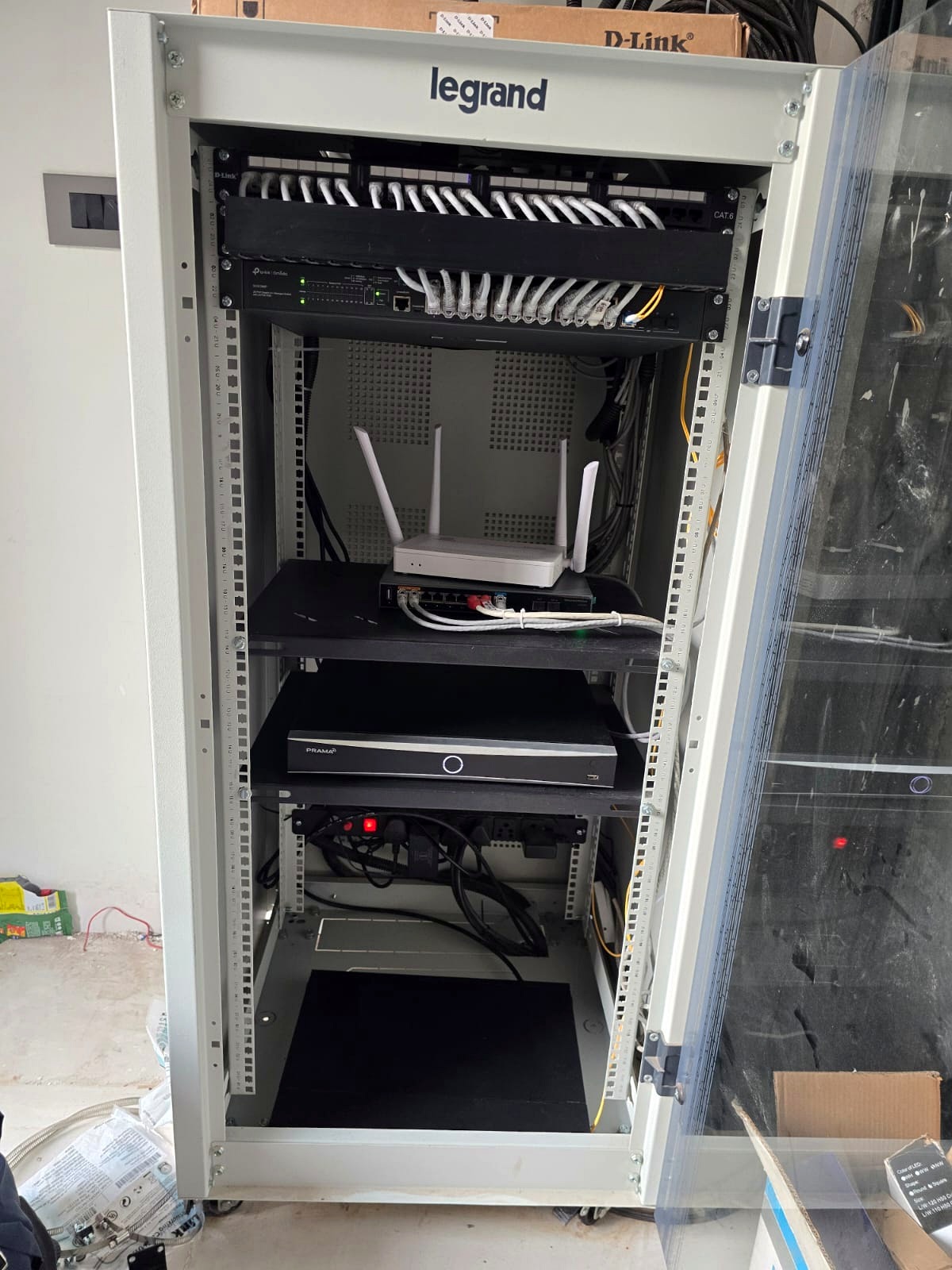
Photographed at commissioning, before the room around it was finished. A D-Link Cat6 patch panel sits over the TP-Link Omada PoE switch that feeds the outdoor access points; the router, the CCTV recorder and the power distribution are on the shelves below, inside a Legrand enclosure.
The fibre legs and the armoured outdoor runs terminate here — which is why the copper leaving this cabinet only has to travel as far as the nearest junction.
Delivered
The property was already built. The network was designed to fit it, not the other way round.