 EX GADGE TRADERS
DesignDeploySupport
EX GADGE TRADERSDesignDeploySupport
Home/Case Studies/Basilica Hotel
Case Study 01 · Hospitality
From guest Wi-Fi to a custom authentication and management system.
A 21-room hotel in Lonavala with a large restaurant and banquet operation, wired and commissioned as one system — and then extended twice in software, because the off-the-shelf equipment could not do what the client asked for next.
Delivered in collaboration with UrbanTech Services LLP.
Basilica was being built out as a full-service property with three very different operations under one roof: a 21-room hotel, a large restaurant open to walk-in diners, and banquet and operational areas. Each of them needed connectivity, security coverage and telephony.
What the client asked for was a complete technology solution — one partner to design and deliver the whole thing — rather than a drawer full of disconnected vendor installs that nobody could manage after handover.
Everything runs from a central distribution point in the server room, out over structured Cat6 copper and single-mode fibre to outdoor junctions and every floor. A MikroTik router sits at the edge, feeding a core switch and managed switches across the server room, the ground floor and the outdoor junction boxes.
The property shares one physical network divided into separate zones — staff, CCTV, hotel guests and restaurant diners — so a congested guest network cannot reach the cameras, and a guest device cannot see the back office. The separation is invisible to everyone using it, which is the point of doing it properly.
More than seventy CCTV cameras sit on their own isolated zone. An EPABX handles internal intercom and external calls across the property, and an online UPS keeps the network, the Wi-Fi and the recorders alive through the power cuts a hill station sees regularly.
Guest Wi-Fi went in the conventional way first: voucher-based access for guests, with room and user-based authentication handled by the TP-Link controller. That covered the property, and it worked.
Then the client asked a different question — could guests be authenticated by SMS instead? The controller could not do that on its own, so the answer had to be built rather than configured.
We put the supporting infrastructure underneath it: an AAA server to handle the authentication, the full DLT regulatory registration completed from scratch, and an MSG91 integration to actually deliver the codes. A guest now connects, enters a mobile number, receives a one-time code, and is online.
With SMS authentication running, a second operational problem surfaced. To see who was actually connected — the phone number, the MAC address, the connection and log information — someone had to log into the controller. That is not something a hotel is going to do several times a day.
So we built a system that brings that information into one management interface: connected devices, the mobile number captured at login, the MAC address, and the connection and log history, in one place instead of buried in network equipment.
The authentication and the management interface only exist because there is a physical system underneath them. This is it.
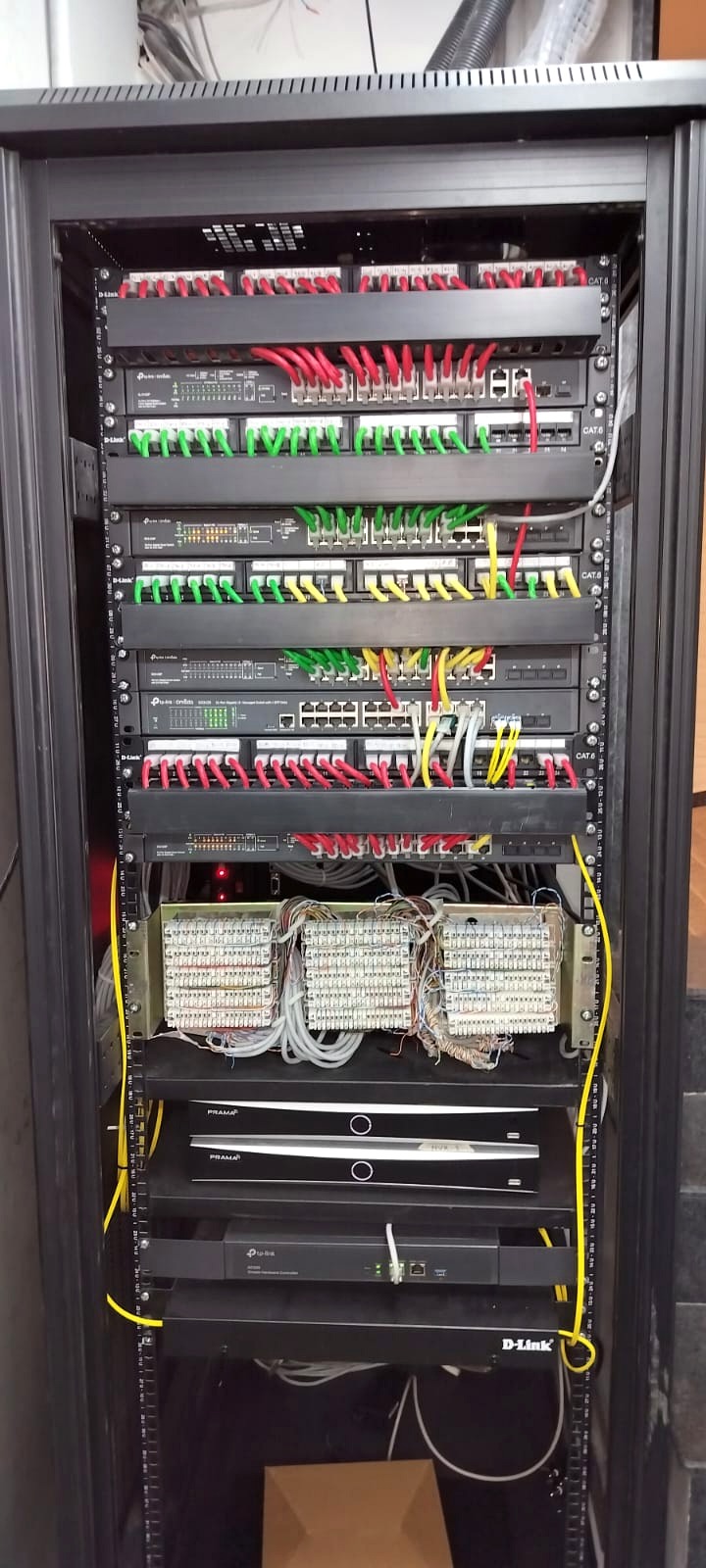
The distribution point the whole property runs from. Colour-coded Cat6 patch leads land on D-Link panels above the TP-Link Omada switches; below them sit the punch-down blocks carrying the EPABX telephony, the CCTV recorders, and the Omada hardware controller that manages the access points.
Every lead is run to length and every panel is labelled, because this is the rack somebody has to work in three years from now.
Delivered
The client got the integrated system they had asked for, rather than five installs that happened to share a building.
The equipment was the straightforward part. The system is what the client actually asked for.